

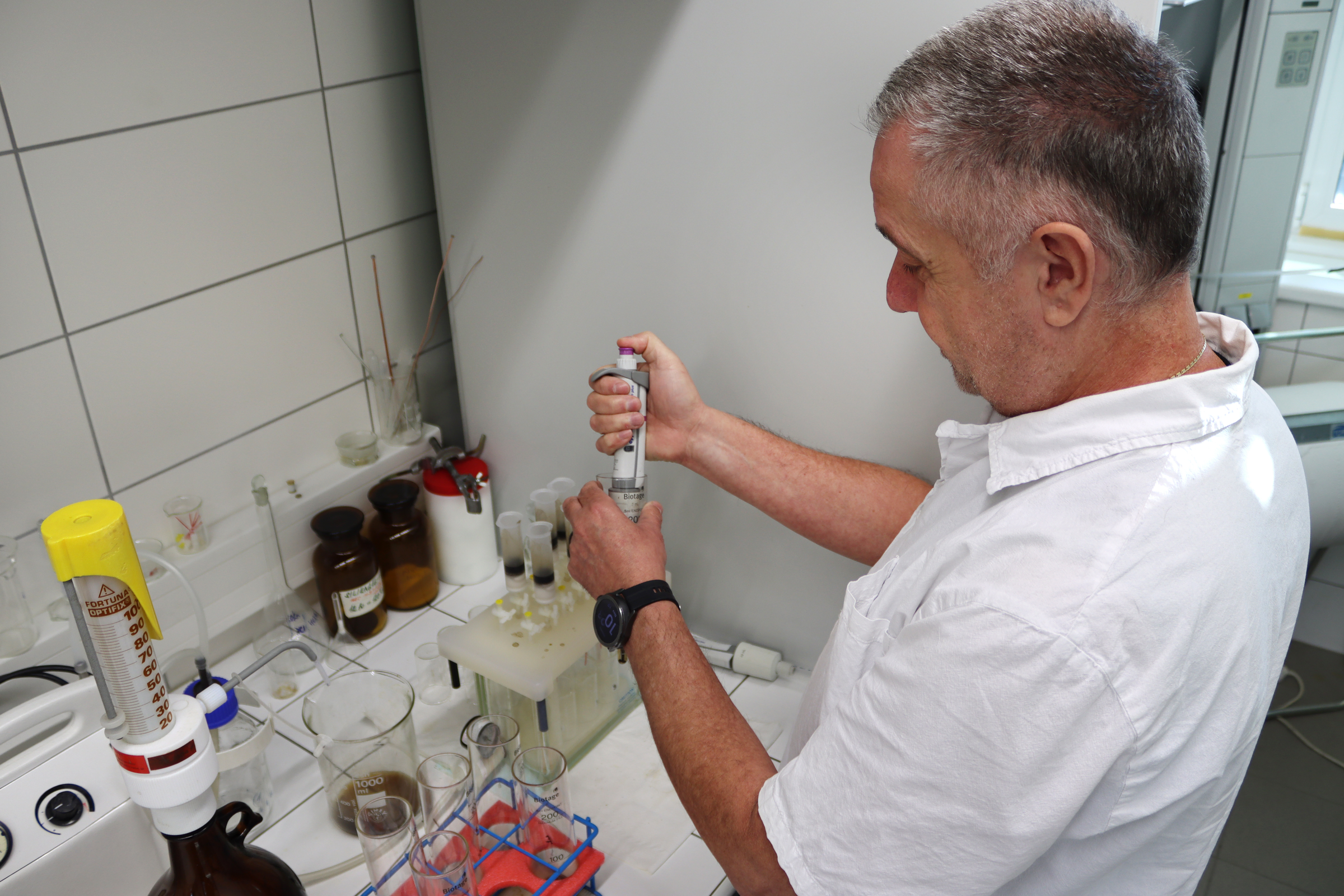
We perform accredited determinations of pollutant concentrations in outdoor air (emissions), traffic noise measurements, and chemical analyses. We measure concentrations of air pollutants specified in Act No. 201/2012 Coll. authorized by the Ministry of the Environment.
We also perform a wide range of measurements and tests in a non-accredited regime for the purpose of comprehensive environmental pollution assessment, including ecotoxicological tests.
We also offer consulting and advisory services focused on assessing the impact of transport on the environment.
News from the laboratory can be found on the website:



A list of accredited exams can be found below:
Osvědčení o akreditaci (PDF; 5.05 MB)
Certificate of Accreditation (PDF; 5.01 MB)
Measurements of concentrations of harmful substances in the air specified in Act No. 201/2012 Coll. Authorized by the Ministry of the Environment: nitrogen dioxide, carbon monoxide, sulfur dioxide, tropospheric ozone, benzene, particulate matter PM10 and PM2.5.
Autorizace k měření úrovně znečištění (PDF; 238.43 KB)
We perform measurements using the Airpointer® device (Recordum Messtechnik GmbH, Austria). Measurements can be performed simultaneously at two locations. The duration of the measurement depends on the client's requirements; various measurement schemes can be agreed upon.
We perform measurements using the VOC71M device (ENVIRONMENT SA, France). We can measure continuously at 15-minute intervals.
We perform measurements using the EnvironCheck 107 device (Grimm aerosol technik, Germany).
We perform measurements using the ELPI® + device (Dekati Ltd., Finland).
We collect individual PM fractions using Leckel MVS6 and Sequential Sampler SEQ 47/50 devices (Sven Leckel Ingenierbüro GmbH, Germany) and TSP – PS-1 devices (Graseby-Andersen, USA).
We perform measurements using the ELPI® + device (Dekati Ltd., Finland).
We use a VEGA TS 5136 LSU scanning electron microscope (SEM) (Tescan s.r.o., Czech Republic) with a Quantax XFlash® 6 energy dispersive analyzer (EDX) (Bruker Nano GmbH, Germany).
Measurements are performed using an 8800 ICP-QQQ-MS instrument (Agilent Technologies, Japan).
Measurements are performed using QP 2010 GC/MS (Shimadzu, Japan) and GC MS/MS Triple Quadrupole 7000C and GC 7890B (Agilent Technologies, Japan) instruments.
We use the GC MS/MS Triple Quadrupole 7000C system, GC 7890B, and Mini Thermal Desorber 7667A (Agilent Technologies, Japan).
We use an AS 300 Control analytical sieving machine, a BB 50 jaw crusher, a PT 100 sample divider, and an MM 400 oscillating mill (all from Retsch, Germany).
We use Speed Wave four microwave equipment (Berghoff GmbH, Germany).
We use the IKA RET control – VISC extractor (IKA, Germany).
test of inhibition of freshwater green algae growth,
test of inhibition of Daphnia magna crustacean motility,
test of inhibition of Sinapis alba germination.
We use the following instruments for testing: INFINITE M 200 Pro Nanoquant spectrophotometer (Tecan Group Ltd., Switzerland), Orion laboratory pH/conductivity meter (Thermo Fisher Scientific Inc., USA), Testo 545 digital luxmeter (TESTO, Czech Republic), TS 606/2-Var thermostatic chamber (WTW instruments, GmbH, Germany), and other equipment.
We perform measurements using the Ysi Professional Plus device (Ysi Inc., USA).
We perform these measurements using equipment developed by the Transport Research Center and SEKO spol. s.r.o.
We perform measurements using the Nicolet iS5 device - Thermo Fisher Scientific Inc., USA.
-512w.webp)
We use cookies for traffic analysis and marketing purposes. Information about how you use our website is also provided to third parties who provide us with analytical and marketing tools, with your consent. Third parties may combine this information with personal data they have obtained from you and may subsequently transfer it outside the EU.
Choose your cookie preferences. Information on how we process cookies can be found in the Cookie Policy.
Cookies of this type are mandatory and cannot be disabled. They are necessary for the proper functioning of the website.
Through these cookies, we can analyze and evaluate the behavior of website visitors. This allows us to improve and tailor our website to your needs.