

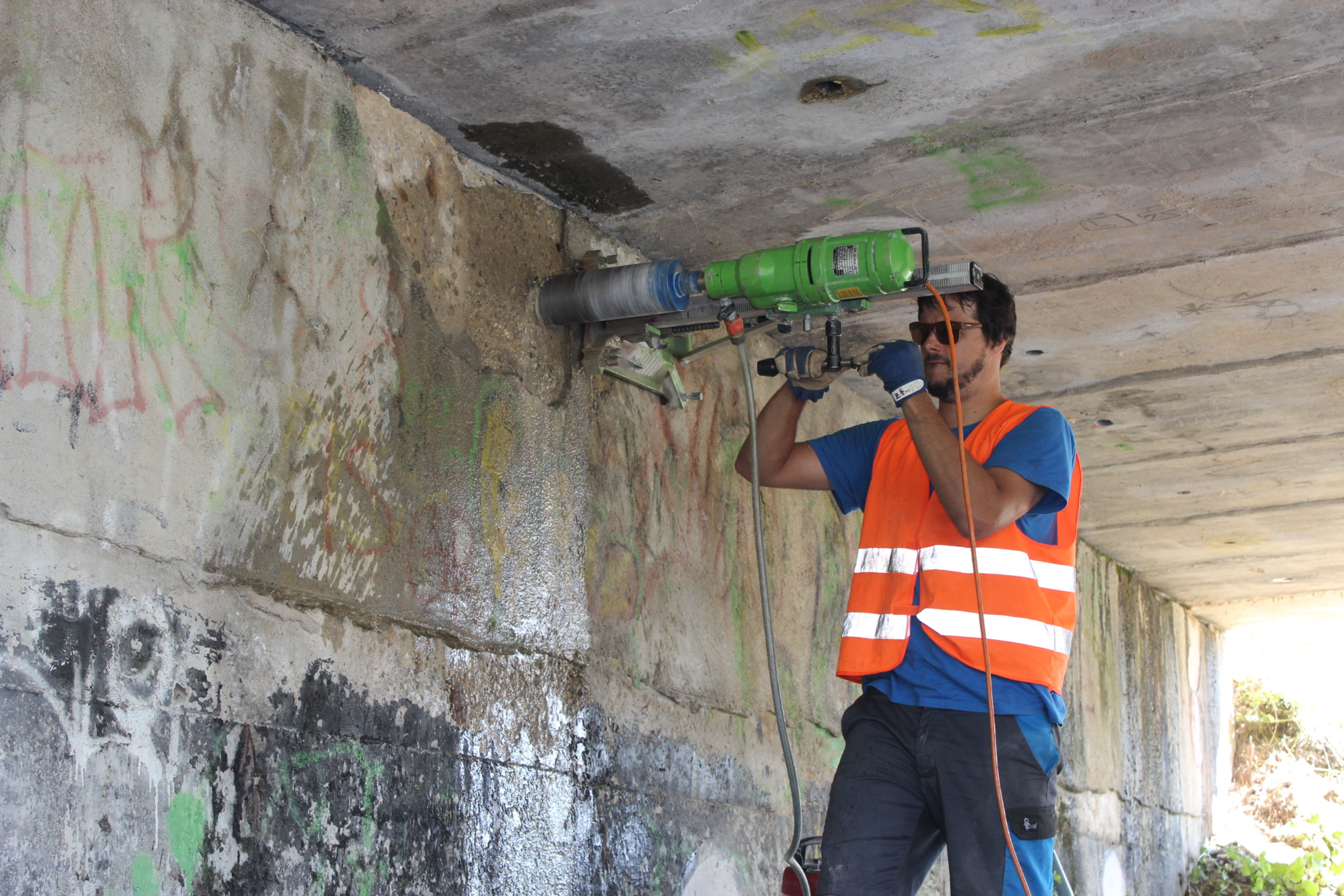
It is accredited for testing the following materials:
concrete in fresh and hardened state, including on-site testing and core sampling,
mortar in fresh and hardened state,
screed materials,
soils - laboratory and field testing,
aggregates - grain size,
and for performing selected tests of building structures, surfaces, and structural layers of roadways.
Other tests and measurements are performed in a non-accredited mode. We also offer consulting and advisory services focused on issues related to materials and structures of transport infrastructure.
A list of accredited exams can be found below:
Osvědčení o akreditaci (PDF; 5.05 MB)
Certificate of Accreditation (PDF; 5.01 MB)
We perform visual inspections, measure road deflections using FWD impact equipment, or measure using ground-penetrating radar, and take core samples and probes for laboratory testing.
We offer road deflection measurements, calculation of layer elasticity modules, and road reinforcement designs. We use FWD/HWD impact testing equipment from RODOS.
Oprávnění Ministerstva dopravy k měření průhybů vozovek pozemních komunikací (PDF; 51.9 KB)
We perform continuous measurements of layer thicknesses, the position of embedded reinforcement, the detection of inhomogeneities, and other applications. To measure walking speeds of up to 80 km/h, we use a dual-channel system from GSSI and antennas with frequencies ranging from 250 MHz to 2.6 GHz (depth range up to 5 m).
We perform static and continuous measurements using FLIR infrared thermal imaging cameras. Thermal images from handheld thermal imaging cameras are typically supplemented with digital photographs of the measured object. In parallel with continuous recording, digital video recordings of the monitored objects are made, together with information about the measurement location.
We offer measurements of road surface unevenness and measurements of cement concrete pavement slab deformation using a rolling profilometer from Stradis, s.r.o. The measurement accuracy is 0.01 mm, and the device allows for the calculation of the IRI parameter.
We continuously monitor height changes during the deformation of cement concrete road slabs, the movement of bridge structures, the movement of road embankments, etc. We use equipment developed in collaboration with the Research Institute of Geodesy, Topography and Cartography, v. v. i., which allows us to monitor changes with a standard deviation of σ ≤ 0.05 mm. Two probes are used – one reference probe and one measuring probe.
We install strain gauges (on the surface or embedded) on monitored structures and elements and ensure that stress values are read during their use/loading. We use a 16-channel QuantumX MX1615B central unit for data collection.
-512w.webp)
We perform analyses on drill cores and samples taken from concrete structures. We determine the occurrence of alkali-silica reactions (ASR), secondary sulfate expansion (ettringite and thaumasite), portlandite, etc. Using a Tescan Vega scanning electron microscope (SEM), we evaluate the degree of pore/capillary filling with these products in relation to the formation of expansion/contraction microcracks. Using energy-dispersive X-ray spectroscopy (EDX), we determine the percentage content of K2O, Na2O, SO3, Cl-, etc., as well as the main oxides in Portland cement clinker relics.
We perform micro-petrographic analyses of individual fractions of aggregate taken from the quarries under assessment; the percentage representation of the rocks and minerals present is determined on prepared thin sections using an Olympus BX53 petrographic (optical polarizing) microscope.
We offer preliminary identification of alkaline silica gel occurrence, which is performed on the fracture or cut surface of concrete (in the laboratory or in the field). We use two reagents: first, sodium hexanitrocobaltate Na3Co(NO2)6 is applied, followed by rhodamine B in the second phase. The resulting color shade is related to the content of K, Na, and Ca elements. The method is sometimes referred to as Los Alamos.
We perform long-term cyclic load tests on road structures under controlled conditions in a laboratory geotechnical test field (LGZP: 9 x 3 m, depth 2.2 m), with the possibility of controlling the water regime in the monitored structure during the test.
Laboratorní geotechnické zkušební pole (LGZP) (PDF; 1.19 MB)
Unbound mixtures and mixtures bound with hydraulic binders (ČSN EN 13286-4).
We perform the test in the laboratory or in-sit.
We perform the test with a ram weight of 10 kg.
In addition to static load tests and light dynamic plate tests, we evaluate the stiffness/modulus of elasticity of subsoil and road base layers in the field using GeoGauge equipment from Humboldt Mfg. Co. (ASTM D6758). The advantage is speed – approximately 20 test sites per hour.
We use cookies for traffic analysis and marketing purposes. Information about how you use our website is also provided to third parties who provide us with analytical and marketing tools, with your consent. Third parties may combine this information with personal data they have obtained from you and may subsequently transfer it outside the EU.
Choose your cookie preferences. Information on how we process cookies can be found in the Cookie Policy.
Cookies of this type are mandatory and cannot be disabled. They are necessary for the proper functioning of the website.
Through these cookies, we can analyze and evaluate the behavior of website visitors. This allows us to improve and tailor our website to your needs.