

The results of the ESRA3 international survey show that Czech drivers frequently exceed speed limits and are largely unsupportive of measures to reduce speed. In the Czech Republic, tolerance for this behavior is higher than in other European countries.
Abstract
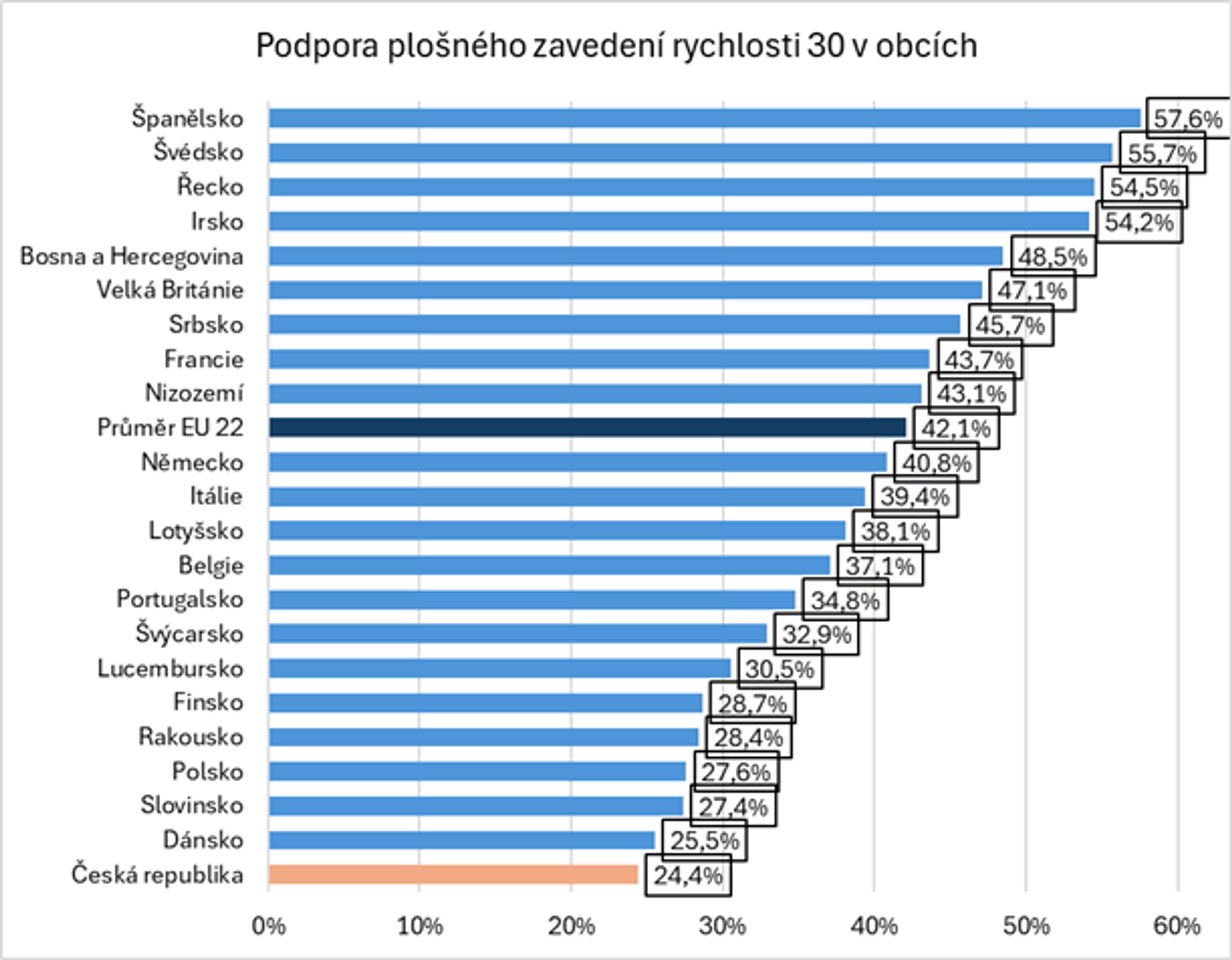
Compliance with the speed limit depends on a number of factors, particularly road design, but also drivers’ attitudes and society’s overall tolerance of risky behavior. This article presents data obtained from the ESRA3 international survey on the behavior and opinions of road users regarding speed; the findings are compared with the results of measurements of indirect safety indicators (hereinafter ISI). Both the survey results and the field monitoring data confirm that the rate of speeding in the Czech Republic is significant. Within Europe, the Czech Republic ranks among the countries with an above-average incidence of this risky behavior, which is moreover tolerated by most road users (with the exception of speeding within built-up areas). More than two-thirds of Czech drivers do not expect to encounter a police check while on the road. Support for speed reduction measures is exceptionally low. The widespread introduction of a 30 km/h speed limit in built-up areas has the lowest support of all 39 countries participating in the ESRA3 project; support for an 80 km/h limit on roads outside built-up areas is the third lowest among participating European countries.
Citatione
SKLÁDANÁ, Pavlína, BUCSUHÁZY, Kateřina, KADULA, Lukáš, KŠICOVÁ, Eva, 2025. Rychlost z hlediska účastníků silničního provozu a jako nepřímý ukazatel bezpečnosti. Silniční obzor. 86 (1), 16-21. ISSN 0322-7154.